NTA UGC NET/JRF Exam, Dec. 2020/June 2021 Commerce (Morning-Shift)

Total Questions: 100

61. Which of the following represents traditional logistics management approach?

(i) Independent inventory management efforts
(ii) Minimise firm costs
(iii) Amount of information sharing and monitoring limited to current processes
(iv) Small breadth of supplier base to increase coordination
Choose the correct answer from the options given below :

Correct Answer: (a) A, B only
Solution:

Following represents traditional logistics management approach :-
Independent inventory management efforts- In traditional approach, there was independent operations the works were done segmented way not in integrated way.

Minimise firms costs -In traditional, approach the focus on to maximise profit by minimising the firms costs.

62. Which of the following statements are false? Indicate the correct code.

(i) No company has to file any prescribed declaration before commencement of business.
(ii)A company can ratify the contract entered into by the promoters with third parties on behalf of the company before its formation.
(iii) The date mentioned in the certificate for commencement of buisness is taken as the date of birth of a public company.
(iv) A private company has to file a "Settlement in lieu of prospectus" with the registrar.
Choose the correct answer from the options given below 

Correct Answer: (c) B, C and D only
Solution:

Following statements are false :-
A company can ratify the contract entered into by the promoters with third parties on behold of the company before its formation.

The date mentioned in the certificate for commencements of business is taken as the date of birth of a public company.

A private company has to file a 'settlement in ........... of prospectus'' with the register.

63. ‘Which of the following are not the objectives of competition act, 2002?

(i) Insure freedom of trade for other participants in incidental and connected markets.
(ii) Provide a reasonable level of reliability and connect operation.
(iii) Adhere to generally accepted security procedures
(iv) Protect the interests of consumers
Choose the correct answer from the options given below : 

Correct Answer: (d) B, C only
Solution:

Objectives of competition Act, 2002
To prevent practices having adverse effect competition
To promote and sustain competition markets.
To protect the interests of consumers
To ensure freedom of trade carried on by ether participants in markets in India and for- matters connected there with or incidental thereto.

64. Which of the following persons cannot use ITR- 4?

(i) Who is director of a company
(ii) Who has held any unlisted equity shares
(iii) Who has any asset located outside India
(iv) A firm (other than LLP) if assessee is a Resident
(v) Who has income from other sources
Choose the most appropriate answer from the options given below : 

Correct Answer: (a) A, B, C only
Solution:

Persons use ITR -4
For individuals and HUFs, firms (other than LLP) being a Resident having Total income upto 50 lakhs and having income from business and profession which is computed under section 44AD, 44AE, 44DA.

Note :- (Not for individual who is either Director in a company or has invented in unlisted equity shares).

65. Which of the following losses are not deductible from business income?

(i) Loss sustained before the business is commenced.
(ii) Lossess incurred in the closing down of the business
(iii) Loss incurred due to damage, destruction, etc .... of capital assets
(iv) Loss of raw material and finished goods in transit
(v) Loss of stock-in-trade due to enemy action
Choose the correct answer from the options given below:

Correct Answer: (a) A, B, C only
Solution:

Following types of business loss are not deductible form business income:-
Losses sustained before the business is commenced.
Losses incurred in the closing down of a business.
Losses incurred due to damage destruction etc of capital assets.
A loss which is not incidental to the carrying on of the business of the assesses.
Loss due to the sale of securities held as investments as it will be a capital loss and not the business loss.
Loss caused by forfeiture of advance given for the purchase of capital assets.
Violation of the law is not a normal incident of trade and an expense incurred by way of penalty for infraction of laws is not allowed for destruction as a business loss.
Trading loss due to loss of goods in transit in the normal course of business.

66. Match List I with List II:

Choose the correct answer from the options given below :

Correct Answer: (b)
Solution:

David Ricardo (1817) -Theory of comparative advantage
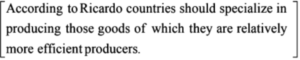
Michael porter (1990)- Theory of competitive advantage.
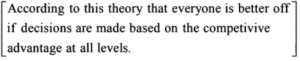
Adam Smith (1776)- Theory of absolute advantage. According to this theory every country will be specialized in producing a product in which it has more advantage than other country.

Heckscher (1919 - ohlin (1933)- Factor Of Endowment Theory
According to this theory, A nation will export the commodity whose production requires the intensive use of the nation's relatively abundant and cheap factor and import the commodity whose production requires the intensive use of the nation's relatively scare and expensive factor.


67. Match List I with List II :


Choose the correct answer from the options and availability given below :

Correct Answer: (b)
Solution:


68. Match List I with List II :


Choose the correct answer from the options given below :

Correct Answer: (c)
Solution:


69. Match List I with List II :


Choose the correct answer from the options given below :

Correct Answer: (b)
Solution:

70. Logically sequence the following in the process of entering international markets outlined in the uppsala model

(i) Sporadic (Ad hoc) exports
(ii) Foreign production and manufacturing
(iii) Establishing a foreign sales subsidiary
(iv) Domestic operations and production
(v) Exporting via independent representative
Choose the correct answer from the options given below : 

Correct Answer: (c) (d), (a), (e), (c) and (b)
Solution:

The process of entering international markets outlined in the uppsala model, in logically sequence are:-
1. Domestic operations and production :- company first should gain domestic market knowledge and production advancement & gain enough experiences to  exports.
2. Sporadic (Adhoc) exports :- No regular export activities
3. Exporting via independent representative:- The company exports systematical through agents.
4. Establishing a forcing sale subsidiary :- If a company is willing to commit its to more export it will take over the middleman's operation and try on its own.
5. Foreign production and manufacturing :- As the company gains enough market knowledge and wants to gain locational advantages. It can starts production there.