Railway Science (Chemistry-Periodic Table)

Total Questions: 50

1. As atomic number______ and nuclear charge_______ the force of attraction between nucleus and valence electrons______.hence, atomic radii______ from Li to F. [RRC Group D 17/08/2022 (Morning)]

Correct Answer: (b) increases, increases, increases, decreases
Solution:

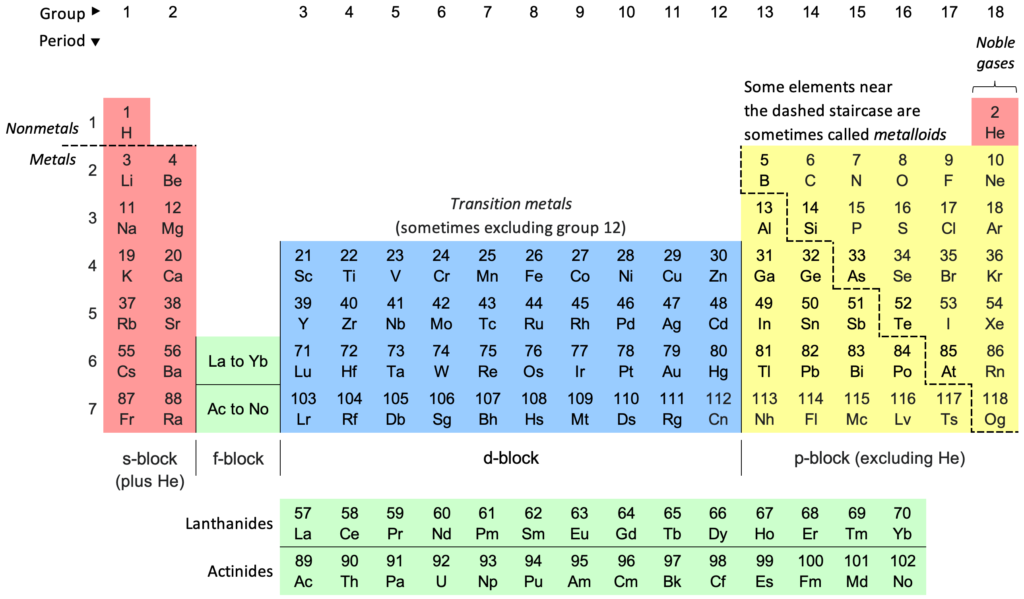
As we move from left to right across a period, Chemical reactivity - First decreases and then increases, Nuclear charge - Increases, Atomic number - increases, Valence electronsincreases, Atomic radii - decreases. As we move down a group, Chemical reactivity- Increases, Atomic numberincreases, Valence electrons- no change, Atomic radii - Decreases.

2. Which factors led the scientists to classify the elements? [RRC Group D 17/08/2022 (Afternoon)]

(i) Different methods of synthesis of elements
(ii) Various sources of elements
(iii) Different properties of elements

Correct Answer: (c) i, ii, iii
Solution:

Elements are classified on the basis of similarities in their properties. Dobereiner grouped the elements into triads and Newlands gave the Law of Octaves. Mendeleev arranged the elements in increasing order of their atomic masses and according to their chemical properties.

3. Which of the following has the maximum non-metallic characters in group 16 elements? [RRC Group D 17/08/2022 (Evening)]

Correct Answer: (d) O
Solution:

According to The Modern Periodic Table, Non - Metallic character decreases down the group and increases across a period. Group 16 elements of the modern periodic table - Oxygen (O)- First element of group 16, Sulfur (S), Selenium (Se), Tellurium (Te) and Polonium (Po), Livermorium (Lv). The decreasing order of electronegativity: O > S > Se > Te > Po.

4. Which of the following elements is the most reactive? [RRC Group D 18/08/2022 (Morning)]

Correct Answer: (d) Ca
Solution:

Ca (Calcium, Atomic Number - 20). Reactivity of metals: K (Potassium) > Na (Sodium) > Ca (Calcium) > Mg (Magnesium) > Al (Aluminium) > Zn (Zinc) > Fe (Iron) > Pb (Lead) > Cu (Copper).
Ca is the most reactive metal (among the options). The chemical reactivity decreases from left to right of the periodic table and it increases down the group in the case of metals.

5. Consider the below statements and identify the correct answer. [RRC Group D 18/08/2022 (Morning)]

Statement I: Dobereiner gave the law of triads.
Statement II: Dobereiner tried to arrange the elements with different properties into groups, having three elements each.

Correct Answer: (d) Only Statement I is Correct.
Solution:

Dobereiner’s triads (a group of three elements) could be formed which shared similar physical and chemical properties. Advantage - The elements can be arranged in specific ways and their properties can be predicted.

6. Which of the following is the most electropositive element? [RRC Group D 18/08/2022 (Afternoon)]

Correct Answer: (a) Cs
Solution:

Cesium (Cs, 55) > Rubidium (Rb, 37) > ,Potassium (K, 19) > ,Sodium (Na, 11)> ,Lithium (Li, 3) . Alkali metals are considered to be the most electropositive as they easily lose electrons to form a cation.
Electropositivity is known to increase down the groups (due to the addition of a new shell) and decrease across periods (atomic sizes decrease due to increase of nuclear charge) in the modern periodic table.

7. Which of the following has the largest atomic radius? [RRC Group D 18/08/2022 (Evening)]

Correct Answer: (a) Iodine
Solution:

Fluorine < Oxygen < Chlorine < Iodine. The atomic radius increases down the group because new shells are being added as we go down the group. The atomic radius is defined as the shortest distance between the atom's nuclei and the outermost shell of the atom.

8. Elements of which of the following groups have the tendency to form acidic oxide? [RRC Group D 22/08/2022 (Morning)]

Correct Answer: (c) 16
Solution:

Group 16 elements are also called chalcogen. Group 13 elements like Aluminium mostly form amphoteric oxides. Group 1 and Group 2 elements form basic oxides.
Acidic oxides: An oxide that either produces an acidic solution upon addition to water, or acts as an acceptor of hydroxide ions effectively functioning as a Lewis acid. Examples- Nitrogen Dioxide, Sulphur trioxide.

9. What is the correct order of elements according to their valence shell electrons? [RRC Group D 22/08/2022 (Afternoon)]

Correct Answer: (a) F>O>C>Li
Solution:

Valence electrons are the electrons orbiting the nucleus in the outermost atomic shell of an atom. Valence electrons of elements - Neon (8), Fluorine (7), Oxygen(6), Nitrogen (5), Carbon (4), Boron (3), Beryllium (2), Lithium (1).

10. Which of the following elements shows maximum valence electrons? [RRC Group D 22/08/2022 (Afternoon)]

Correct Answer: (a) F
Solution:

Fluorine (F) has the highest valence shell electron (7).