Railway Science (Chemistry-Periodic Table)

Total Questions: 50

11. Which of the following triads is NOT a Dobereiner's triad? [RRC Group D 22/08/2022 (Evening)]

(i) Li, Na, K         (ii) Ca, Sr, Ba

(iii) N, P, Sb        (iv) Cl, Br, I

Correct Answer: (c) Only iii
Solution:

A group of elements with identical properties, states that the atomic masses of the first and third elements in the triad would be approximately equal to the atomic mass of the second element in the triad.
Triad 1 (alkali metals sodium (Na), potassium (K), and lithium (Li)), Triad 2 (barium (Ba), strontium (Sr), and calcium (Ca)), Triad 3 (halogens bromine (Br), iodine (I), and chlorine (Cl)).

12. Consider the statements below and identify the correct answer; [RRC Group D 23/08/2022 (Morning)]

Statement I: Among chemical properties, Mendleev concentrated on the compounds formed by elements with carbon and hydrogen.
Statement II: He selected these elements as they are less reactive and formed compounds with few elements.

Correct Answer: (b) Both statements are incorrect.
Solution:

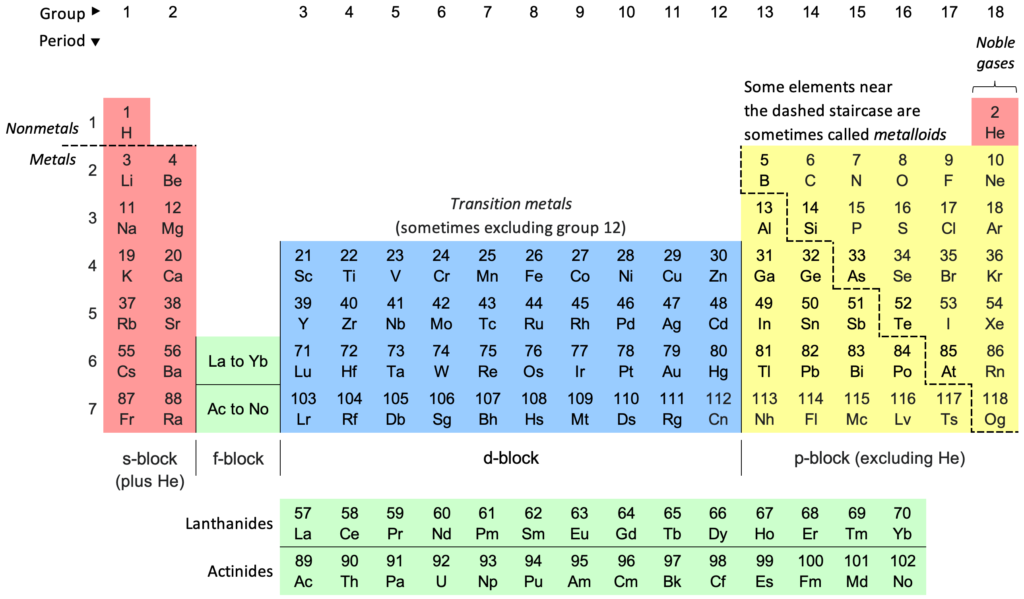
Dmitri Mendeleev - Father of the Modern Periodic Table. Modern periodic law - The table is the arrangement of elements in increasing order of their atomic numbers, consisting of 18 vertical columns (groups) and 7 horizontal rows (periods).

13. At present,_______elements are known, of which________ are naturally occurring elements. [RRC Group D 23/08/2022 (Afternoon)]

Correct Answer: (d) 118, 94
Solution:

A chemical element is a chemical substance that cannot be broken down into other substances. An element is composed of atoms of the same kind. These elements are mildly distributed in the earth's crust in the free as well as combined form.
The elements following uranium on the periodic table are only produced artificially, and are known as the transuranium or transuranic elements. 24 elements are prepared artificially.

14. Four different elements and their atomic numbers are given: A (9), B (11), C (19) and D (37). With reference to their positions in the periodic table, choose the odd one out from these. [RRC Group D 23/08/2022 (Evening)]

Correct Answer: (c) A
Solution:

The electronic configuration of elements will be Fluorine (A,9) - (2,7). Sodium (B,11) - (2, 8, 1). Potassium (C,19) - (2, 8, 8, 1). Rubidium (D,37) - (2, 8, 8, 18, 1). The pattern shows that all elements (except element with atomic number 9) have 1 electron in their outermost valence shell and all these elements belong to alkali metals.

15. A whose position in the modern periodic table is inconsistent on the basis of its properties. Its electronic configuration is similar to that of the alkali metals, but it exists as diatomic molecules. B is the element that comes immediately after sodium in the third period, and belongs to group C in the modern periodic table. Identify A, B and C. [RRC Group D 24/08/2022 (Morning)]

Correct Answer: (a) A = Hydrogen, B = Mg, C = 2
Solution:

Atomic number 1 and electronic configuration 1s¹ is the first element. It resembles alkali metals as well as halogens. Hence, its position is anomalous. Magnesium (Mg) - Atomic number 12, one of the alkaline-earth metals of Group 2A (IIa) of the periodic table, and the lightest structural metal. Diatomic molecules - made up of two atoms. Examples - hydrogen (H₂), Oxygen (O₂), Carbon monoxide (CO), Nitric oxide (NO) etc.

16. Choose the incorrect statement from the following. [RRC Group D 24/08/2022 (Afternoon)]

(i) Newland arranged the elements in order of increasing atomic masses and gave the law of octaves.
(ii) Sodium is the eighth element after lithium.
(iii) Calcium is the eighth element after beryllium.
(iv) The law of octaves was applicable only up to magnesium, because every eighth element after magnesium did not have the same properties as the first.

Correct Answer: (a) iv
Solution:

The law of octaves states that every eighth element has similar properties when the elements are arranged in the increasing order of their atomic masses.The law was named so because he compared it to the octaves found in the music scale. Newlands law of octaves was discarded because it failed to arrange larger elements beyond Calcium.

17. From total _____ elements, _______ elements were discovered through laboratory processes. [RRC Group D 24/08/2022 (Evening)]

Correct Answer: (d) 118, 24
Solution:

Total elements - 118, out of which only 94 are naturally occurring while 24 (synthetic elements) (atomic numbers 95–118) are discovered through laboratory Processes. Technetium - the first artificially produced element. In the Periodic table, rows - periods and Columns - groups.

18. Identify the INCORRECT order for the number of valence shell electrons. [RRC Group D 24/08/2022 (Evening)]

Correct Answer: (b) Al<P<Si<S<Cl
Solution:

Elements (Atomic number, Valency) - Aluminium (Al) (13, 3) < Silicon (Si) (14, 4) < Phosphorus (P) (15, 3 ) < Sulfur (S) (16, 2) < Chlorine (Cl) (17, 1). Lithium (Li) (3, 1), Beryllium (Be) (4, 2), Boron (B) (5, 3), Carbon (C) (6, 4), Nitrogen (N) (7,3), Sodium (Na) (11, 1), Magnesium (Mg) (12, 2), Argon (Ar) (18, 0), Fluorine (F) (9, 1), Neon (Ne) (10, 0).
The electrons present in the outermost shell of an atom are called valence electrons. Valency - number of electrons required to complete octet. There are four types of orbital present in atoms - s, p, d, f.

19. Which of the following groups represents zero valency? [RRC Group D 25/08/2022 (Morning)]

Correct Answer: (a) 18
Solution:

Group 18 elements/Noble gasses (He, Ne, Ar, Kr, Xe, and Rn) - They have valency zero because they do not have any free electrons. Except Helium (which have only 2 electrons & hence duplet), all the other elements have complete octet i.e. have 8 electrons in the valence shell (completely filled). So, they neither gain electrons nor lose any electrons & are stable without going into any reaction.

20. Select the element with the highest valency from among the following. [RRC Group D 25/08/2022 (Morning)]

Correct Answer: (d) N
Solution:

Valency is the number of electrons gained/lost or shared by an atom to achieve the noble gas configuration. Nitrogen (N) - group 15, atomic number 7. Electronic configuration 1𝑠² 2𝑠² 2𝑝³ .
It has 5  electrons in the valence shell, so it requires 3 electrons to complete its octet. So, the valency of nitrogen is 3. Similarly, Ca (2), Al (3), Li (1).