Railway Science (Chemistry-Periodic Table)

Total Questions: 50

21. The atomic size ________ moving from left to right and _______ moving from up to down in the periodic table. [RRC Group D 25/08/2022 (Evening)]

Correct Answer: (b) decreases, increases
Solution:

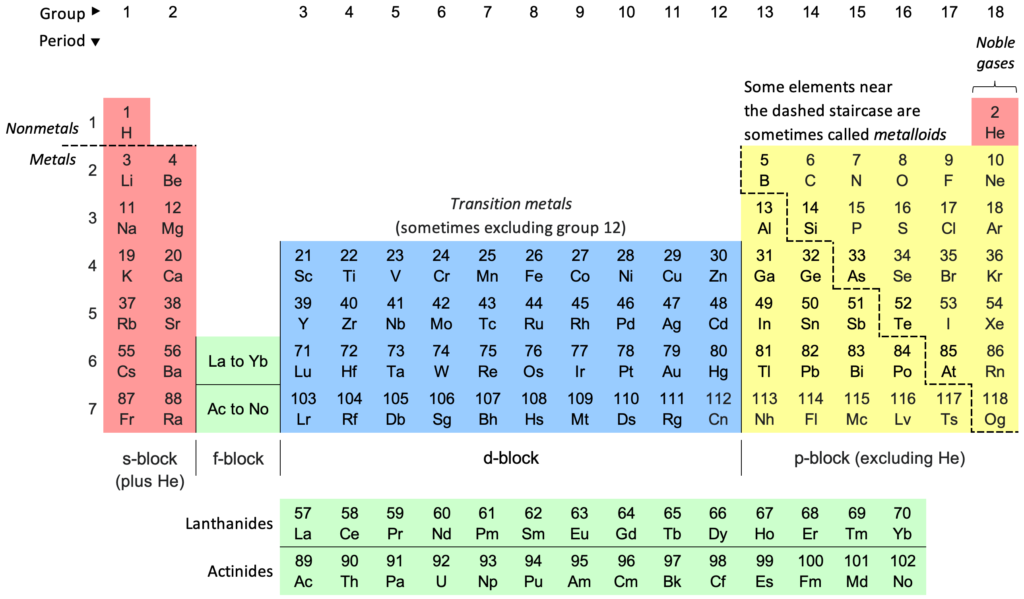
The atomic radius decreases across a period (Horizontal Row) and increases down a group (Vertical Column). Across a period, effective nuclear charge increases as electron shielding remains constant.
It causes greater attractions to the electrons, pulling the electron cloud closer to the nucleus which results in a smaller atomic radius. Down a group, the number of energy levels increases, so there is a greater distance between the nucleus and the outermost orbital. This results in a larger atomic radius.

22. Consider the below statements and identify the correct answer. [RRC Group D 25/08/2022 (Evening)]

Statement I: Lithium, Sodium and Rubidium are elements of Dobereiner’s triad.
Statement II: In triads, the atomic mass of the middle element was roughly the average of the atomic masses of the other two elements.

Correct Answer: (a) Statement II is correct, Statement I is incorrect.
Solution:

Dobereiner’s triad - Groups of three elements (triads) with similar physical and chemical properties where the arithmetic mean of the atomic masses of the first and third element in a triad would be approximately equal to the atomic mass of the second element.
Examples - {lithium (Li), Sodium (Na) and Potassium (K)}, {Calcium (Ca), Barium (Ba) and Strontium (Sr)}, {Chlorine (Cl), Bromine (Br) and Iodine (I)}, {Sulphur (S), Selenium (Se), and Tellurium (Te)}, {Iron (Fe), Cobalt (Co) and Nickel (Ni)}.

23. Which of the following is not a feature of Mendeleev's periodic classification? [RRC Group D 26/08/2022 (Afternoon)]

Correct Answer: (d) Correct position of the isotopes.
Solution:

Features of Mendeleeve’s Periodic Classification: Vertical columns (groups - 8) and horizontal rows (periods - 7). All the groups are divided into subgroups. Along with that he left some vacant spaces in the periodic table. Example - Left a vacant space below aluminium and germanium and named them Eka - aluminium and Eka - silicon.

24. Which elements were named by Mendeleev by prefixing the word 'Eka (one)' to the names of their predecessors in the same group? [RRC Group D 26/08/2022 (Afternoon)]

Correct Answer: (a) Scandium, Gallium and Germanium
Solution:

Scandium, Gallium and Germanium. Features of Mendeleeve’s Periodic Classification: Vertical columns (groups - 8) and horizontal rows (periods - 7). All the groups are divided into subgroups.Along with that he left some vacant spaces in the periodic table.
He then named them eka-boron, eka -aluminium and eka-silicon.Eka-boron, Eka-aluminium and Eka-aluminium are now known as scandium, Gallium and Germanium respectively.

25. Consider the statements given below, and choose the correct answer. [RRC Group D 26/08/2022 (Evening)]

Statement I : Atomic radius increases on moving from left to right in a period.
Statement II : Nuclear charge increases on moving from left to right in a period.

Correct Answer: (d) Only statement II is correct.
Solution:

The atomic radius generally decreases from left to right across a period (due to increasing nuclear charge) and increases down a group (due to the increasing number of electron shells). Effective nuclear charge increases across the period from left to right.

26. What is the order of K, L and M shells in terms of the total number of electrons? [RRC Group D 29/08/2022 (Morning)]

Correct Answer: (d) M > L > K
Solution:

The maximum number of electrons that can be filled in the shell K, L, M, N respectively are 2, 8, 18, 32. The maximum number of electrons that can be accommodated in any shell according to Bohr and bury is 2 × 𝑛² , where n is the shell number. K-Shell 2 = 2 × 1²  = 2. L - Shell = 2 × 2² = 8. and soon.

27. There are four elements P, Q, R and S and their atomic numbers are 2, 6, 13 and 18 respectively. Which of the following pairs has elements having similar valency? [RRC Group D 29/08/2022 (Afternoon)]

Correct Answer: (c) P and S
Solution:

P = 2 – It is a Noble gas. Hence, Valency = 0
Q = 6 – 2, 4 - It needs 4 electrons to complete the octet.
Hence, valency = 4 R = 13 - 2, 8, 3 – It needs to lose the last 3 electrons to complete the octet.
Hence, valency = 3 S = 18 – It is a Noble gas. Hence, Valency = 0
So, P and S have the same valency.

28. Which of the following elements has valency 3 ? [RRC Group D 30/08/2022 (Morning)]

Correct Answer: (d) AI
Solution:

Atomic number of aluminum is 13 so its electronic configuration is 2, 8, 3. Since it has 3 electrons in its valence shell, it will lose 3 electrons to complete its octet hence its valency is +3.
If the number of valence electrons are less than or equal to 4, the valency = number of valence electrons. If the number of valence electrons are greater than 4, the valency = 8 - the number of valence electrons. So, valency of Sulphur = 2, Carbon = 4, Magnesium = 2.

29. Which of the following was the main defect of Dobereiner's triad ? [RRC Group D 30/08/2022 (Afternoon)]

Correct Answer: (b) He was unable to form more than three triplets of elements.
Solution:

Dobereiner’s triads (a group of three elements) could be formed which shared similar physical and chemical properties. Advantage - The elements can be arranged in specific ways and their properties can be predicted.

30. Oxygen has_____ electrons in its outermost ________ shell. [RRC Group D 30/08/2022 (Evening)]

Correct Answer: (b) 6, L
Solution:

The maximum number of electrons - accommodated in a shell - based on principal quantum number (n). It is represented by the formula 2n² .
K shell n = 1 Maximum Electron - 2 × 1² = 2 , L shell n = 2 Maximum Electron - 2 × 2²  = 8, M shell n = 3 Maximum Electron - 2 × 3² × = 18, N shell n = 4 Maximum Electron - 2 × 4²  = 32.
Oxygen (O₂ ) is highly reactive non metal belongs to group 16 and it has 8 electrons so 2 in K shell and 6 in L shell. Element in Group - 16 known as Chalcogens or Ore - Forming elements.