Railway Science (Chemistry-Periodic Table)

Total Questions: 50

31. How many electrons are present in an L-Shell of a carbon atom? [RRC Group D 30/08/2022 (Evening)]

Correct Answer: (a) 4
Solution:

The maximum number of electrons - accommodated in a shell - based on principal quantum number (n). Carbon is a chemical element with the symbol C and atomic number 6. It has 2 electrons in the K-shell and 4 electrons in the L- shell. It belongs to group 14 of the periodic table.

32. Identify the correct order if A, B C, D, E are the atomic numbers of the elements in positions of rows 1 to 4 of the periodic table of Groups 15, 16, 17 respectively, as specified in figure below [RRC Group D 01/09/2022 (Morning)]

Correct Answer: (c) D>B>E>C>A
Solution:

The element A represents the 1st element of group 15 in the periodic table is nitrogen (N) (Z = 7). Similarly, B - antimony (Sb) (Z = 51), C - Oxygen (O) (Z = 8), D - Tellurium (Te) (Z = 52), E - Bromine (Br) (Z = 35). So the correct order will be D>B>E>C>A.

33. As we move down the group, the tendency for formation of alkaline oxides is _______ . [RRC Group D 01/09/2022 (Afternoon)]

Correct Answer: (b) Increases
Solution:

In the Modern periodic table, basic character decreases from left to right across periods and increases from top to bottom among groups. More electropositive the central atom - more basic the oxide.
More electronegative the central atom - More acidic the oxide. Amphoteric oxides - Oxides which behave as both acidic and basic oxides, Example - Al₂O₃ .

34. Match the following characteristics in the modern periodic table. [RRC Group D 01/09/2022 (Afternoon)]

Codes:

iiiiiiivv
(a)ecabd
(b)abcde
(c)badce
(d)adbec
Correct Answer: (d)
Solution:

Total number of blocks in the modern periodic table are 4 - s-block, p-block, d-block, f-block. A period is a horizontal row of the periodic table. There are seven periods in the periodic table.

35. Which of the following is the most electronegative element? [RRC Group D 01/09/2022 (Evening)]

Correct Answer: (a) Cl
Solution:

The tendency of an atom in a molecule to attract the shared pair of electrons towards itself is known as electronegativity. Chlorine (Cl) has an electronegativity of 3.16, Since Cl has 7 valence electrons, it really wants to attract one to complete its octet.
This means electronegativity will be higher. Electronegativity values of Sulfur, Aluminium, Magnesium are 2.58, 1.61 and 1.31 respectively. Fluorine (3.98) is the most electronegative element on the periodic table. Cesium (0.7) and Francium (0.7) are the least electronegative elements.

36. Mendeleev's periodic table examined the relationship between the atomic mass of elements and their_____. [RRC Group D 01/09/2022 (Evening)]

Correct Answer: (b) physical and chemical properties both
Solution:

Dmitri Mendeleev was the first to classify elements on the basis of their fundamental property, the atomic mass, and also on the similarity of chemical properties. When Mendeleev started his work, 63 elements were known. He examined the relationship between the atomic masses of the elements and their physical and chemical properties.
It was also observed that there occurs a periodic recurrence of elements with similar physical and chemical properties . On this basis Mendeleev formulated a periodic law which states that "The properties of the elements are the periodic function of their atomic masses".

37. Which of the following properties is NOT governed by the position of elements in the Periodic Table? [RRC Group D 02/09/2022 (Morning)]

Correct Answer: (d) Colour of element
Solution:

In the periodic table, atomic radii decrease from left to right across a row and increase from top to bottom down a column. The number of valence electrons increases from left to right across each period and decreases from top to bottom within each group.
Valency of an element always depends on the valence electrons or the number of electrons present in the outermost shell. Valency first increases and then decreases as we go from left to right in a period but remains the same in a group.

38. Which of the following elements has the highest effective nuclear charge? [RRC Group D 02/09/2022 (Morning)]

Correct Answer: (c) F
Solution:

In a period from left to right, nuclear charge increases. Therefore, F has the highest nuclear charge among all, and on moving down the group, the effective nuclear charge decreases due to addition of electrons in the shells moving away from the nucleus. In the Modern periodic table, Na lies below Li in same group (alkali metals) hence, it has the least nuclear charge among the given options.
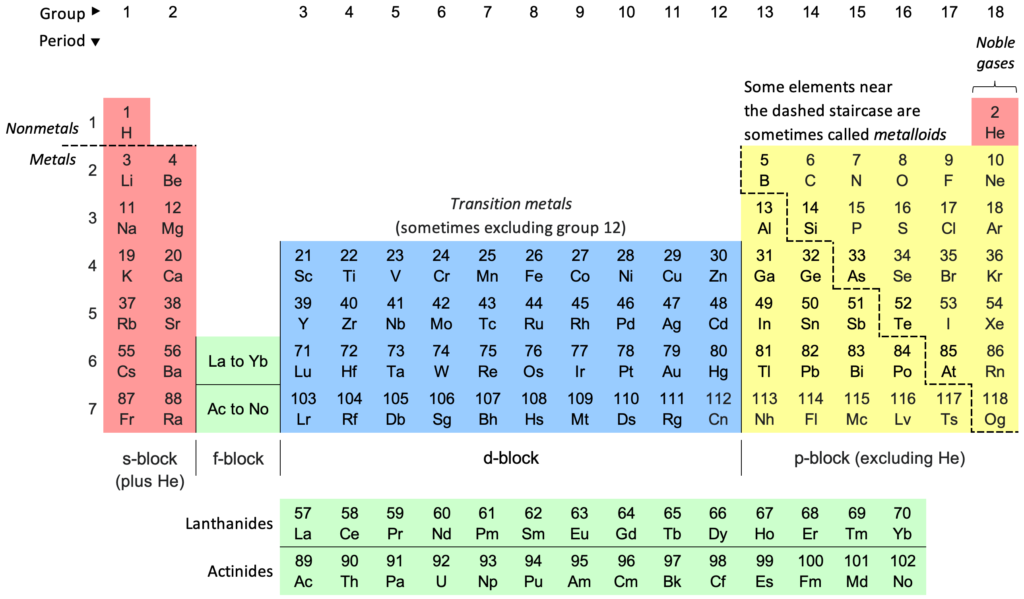

39. An element X combines with chlorine to form a compound XCI. The element X is placed on the left side of the periodic table. Which of the following statements are correct for element X? [RRC Group D 02/09/2022 (Evening)]

(i) Has one valence electron.
(ii) Is a metal and is solid.
(iii) Is a non-metal and is a gas.
(iv) Has five valence electrons.

Correct Answer: (b) Only (i) and (iii)
Solution:

The element X can be Hydrogen because it is non metal, gas and has valence electron 1. It combine with Chlorine to form HCl which is a strong acid. HCl lewis structure has one bond pair and three lone pair electrons. Group1 elements react with Chlorine to form Chlorides.

40. Select the incorrect statements from among the following. [RRC Group D 05/09/2022 (Afternoon)]

i. When Mendeleev started his work on the periodic table, 63 elements were known.
ii. Mendeleev concentrated on the compounds formed by elements with oxygen and hydrogen.
iii. Mendeleev examined the relationship between the atomic numbers of the elements.
iv. Mendeleev examined the relationship between the physical and chemical properties of the elements.

Correct Answer: (b) iii
Solution:

Dmitri Mendeleev (Russian chemist) - important contributor to the early development of the periodic table. When Mendeleev selected his work,on the periodic table. He observed that the chemical and physical properties of the elements recur periodically when the elements are arranged in the order of their atomic weights.