Railway Science (Chemistry-Periodic Table)

Total Questions: 50

41. An element belongs to period 2 and group 2 the number of valence electrons in the atoms of this element is: [RRC Group D 05/09/2022 (Afternoon)]

Correct Answer: (c) 2
Solution:

The group 2 elements - alkaline earth metals (Beryllium, Magnesium, Calcium, Barium, Strontium and Radium). The group of an atom tells the number of valence electrons holded by an atom, the period number tells the number of shells present in an atom. Valence Electrons - alkali metals group (1) - 1, boron group (13) - 3, carbon group (14) - 4.

42. The triad of group 2 metals consists of which of the following elements? [RRC Group D 05/09/2022 (Evening)]

Correct Answer: (c) Ca, Sr, Ba
Solution:

The Group 2 alkaline earth metals include Beryllium (Be), Magnesium (Mg), Calcium (Ca), Barium (Ba), Strontium (Sr) and Radium (Ra). Although many characteristics are common throughout the group, the heavier metals such as Ca, Sr, Ba, and Ra are almost as reactive as the Group 1 Alkali Metals. All the elements in Group 2 have two electrons in their valence shells, giving them an oxidation state of +2.

43. Chlorine, bromine and iodine make a Dobereiner's triad. The average of atomic masses of chlorine and Iodine would be close to ________. [RRC Group D 05/09/2022 (Evening)]

Correct Answer: (c) 79.9
Solution:

Chlorine(Cl), bromine(Br) and iodine(I) make a Dobereiner's triad.
⇒ Atomic masses of Chlorine(Cl) = 35.5,
⇒ Atomic mass of Iodine(I) = 126.92
∴ The average value of the atomic masses of Cl and I = (35.5 + 126.92)/2 = 81.2 (actual is 79.9).

44. Element X has a total of 16 protons and 16 neutrons. It is related to ________. [RRC Group D 06/09/2022 (Evening)]

Correct Answer: (d) third period and sixteenth group
Solution:

Finding period and group of an element: Elements having similar outer electronic configurations in their atoms are arranged in groups. The period indicates the value of n for the outermost or valence shell.
The period is equal to the number of shells present in an atom. atomic number - number of protons in the nucleus. 118 elements present in the periodic table.

45. Match the following characteristics in Modern Periodic Table: [RRC Group D 08/09/2022 (Morning)]

Codes:

iiiiiiivv
(a)ecadb
(b)ecabd
(c)abcde
(d)adbec
Correct Answer: (b)
Solution:

The tendency of an atom in a molecule to attract the shared pair of electrons towards itself is known as electronegativity. Fluorine (F) is the most electronegative element with a value of 4.0 and Francium (Fr) and Cesium (Cs) are the least electronegative element with a value of 0.7. Metallic character refers to the level of reactivity of a metal It decreases from left to right and increases on top to bottom. Example - Cesium (Cs) - last naturally occurring element in Group 1 is the most metallic element.

46. What is the correct order of periods in terms of number of elements? [RRC Group D 09/09/2022 (Morning)]

Correct Answer: (b) 1<2=3<4=5<6=7
Solution:

Period 1 has only two elements (hydrogen and helium), while periods 2 and 3 have 8 elements. Periods 4 and 5 have 18 elements. Periods 6 and 7 have 32 elements, because the two bottom rows that are separate from the rest of the table belong to those periods.

47. Whenever moving from left to right in a period, metallic character ________. [RRC Group D 09/09/2022 (Morning)]

Correct Answer: (b) decreases
Solution:

The metallic character of an element depends on how readily it can lose its electrons. On moving across a period, nuclear pull increases due to the increase in atomic number and thus the atomic size decreases. Hence, elements cannot lose electrons easily. Therefore, the metallic nature decreases across a period moving from left to right.

48. Newlands' Law of Octaves worked well with: [RRC Group D 09/09/2022 (Afternoon)]

Correct Answer: (b) lighter elements only
Solution:

If the chemical elements are arranged according to increasing atomic weight, the properties of every eighth element are similar to the first element. It worked upto Calcium (Ca, atomic mass - 40) and failed for heavier elements.

49. The elements having atomic numbers 15, 16, 17, and 18, respectively, are: [RRC Group D 09/09/2022 (Evening)]

Correct Answer: (a) P, S, Cl and Ar
Solution:

The elements having atomic numbers: 1 - Hydrogen (H), 2 - Helium (He), 3 - Lithium (Li), 4 - Beryllium (Be), 5 - Boron (B), 6 - Carbon (C), 7 - Nitrogen (N), 8 - Oxygen (O), 9 - Fluorine (F), 10 - Neon (Ne), 11 - Sodium (Na), 12 - Magnesium (Mg), 13 - Aluminum (Al), 14 - Silicon (Si), 15 - Phosphorus (P), 16 - Sulfur (S), 17 - Chlorine (Cl), 18 - Argon (Ar), 19 - Potassium (K), 20 - Calcium (Ca).
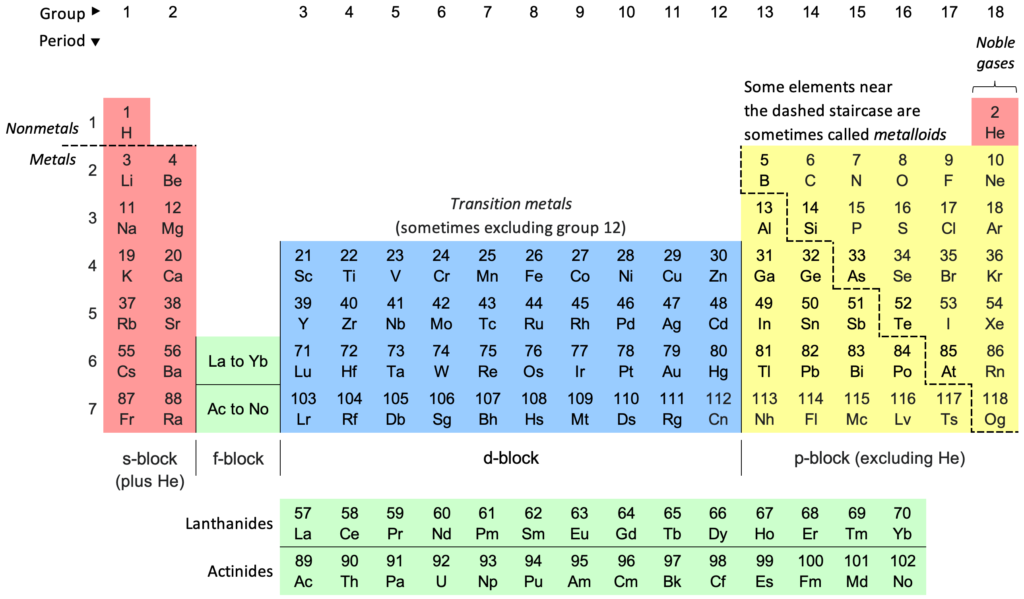

50. Which of the following elements has the highest atomic radius? [RRC Group D 12/09/2022 (Morning)]

Correct Answer: (c) Li
Solution:

The atomic radius of a chemical element is a measure of the size of its atom, usually the mean or typical distance from the center of the nucleus to the outermost isolated electron.
In the periodic table, atomic radius generally decreases as you move from left to right across a period (due to increase in nuclear charge) and increases as you move down a group (due to the increasing number of electron shells).